

How Type Can Help You Know Yourself
By Carol A. Linden

Carol A. Linden, MBTI Master Practitioner, speaker, author, consultant; past APTI president, current APTI Board member, has served APTI since 1998. ENFP preferences. After 26 years in a software company, she learned the importance of flexing at work, including speaking the language of those around her who were not like her. “Type saved my sanity in corporate America and made my career possible.” I love this topic.
Why Understanding Type is Worth Doing
Using psychological type (and Temperaments and Interaction Styles™) improved my life in more ways than I can count. So why is learning about type worth the investment of your time and energy? Because learning about type and applying your learning makes it possible for you to
- reduce misunderstandings and conflict in both your work life and personal life.
- make choices that will align best with “your insides.”
- understand why some people regularly drive you nuts—and why you probably drive them nuts.
- and learn to flex so that nobody has to drive anybody nuts.
If these benefits look worth it to you, read on.
People See the World Very Differently: Filters
You’ve run into this, right? You hear an account of a meeting from a few people and you think, “Were they all in the same meeting?” Or, you’re looking at a situation that your co-worker or spouse sees very differently than you do. And you just can’t see where they’re coming from. Often what is at play is that you have different psychological type preferences, so your mind perceives the situation differently and makes decisions using a different yardstick than their mind uses. We all have filters through which we see the world. What few of us are taught in school but is pretty obviously true:
We do not see the world the way it is.
We see the world the way that we are.
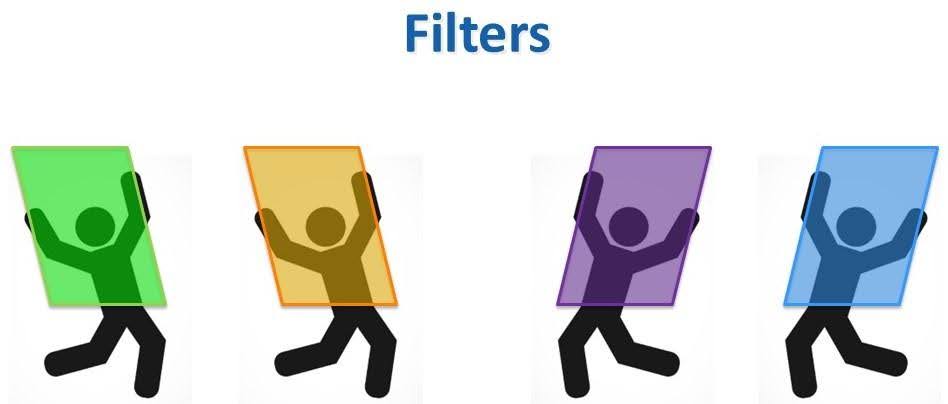
While we all have filters that we use to see the world, we can become more conscious of our own and learn about different filters that other people use.

Once you recognize the kinds of natural, innate differences in psychological type, you can start to see things from the other person’s perspective and not get stuck in your own. When we see the world through only our own lens, we tend to make other people wrong. And, I don’t think I have to tell you how counterproductive that strategy is.
Note: gratitude to Linda V. Berens, Ph.D., for teaching me about filters.
Type Application 1: Manage your filters
I have a filter that says spontaneity is great. Nothing wrong with that. Nothing except that it is not effective when I assume everyone else sees things that way too.
When my mother was turning 50, I thought it would be great to tell the family—but not her—that I was coming, get my brother-in-law to pick me up at the airport, arrive at my mother’s house and say, “Surprise!”
I approached my stepfather with this plan. Now, he was a thoughtful man. He paused, then said, “Carol Ann, I’ve been married to your mother for 20 years. If there’s one thing I’ve learned, it is that she does not like surprises.”
He was a wise man. I followed his advice and told Mother that I wanted to come to celebrate her birthday. So she got the chance to make all her preparations—she’s a bit of a perfectionist—and plans. (Mother loves plans.) She was elated to see me.
Thanks to my stepfather’s wisdom about how different she and I were, I made the choice that made her happy and comfortable. Without his help, I would have assumed that everyone would love for me to show up, unannounced, at their doorstep, shouting, “Surprise!” And everyone probably would have been surprised, but not everybody would have been happy with me.
Type Application #2: Reduce Misunderstandings – How to Not Put Off Your Colleagues
How Bill Learned to Smile
I volunteered for a jobseekers’ networking group for 10 years and met a lot of great people. They loved learning about type to help them with interviews. (But, that’s a story for another day.) When I noticed a volunteer working at the reception table, I said, “Bill, that’s a great smile you have there.” He laughed and said, “If you only knew.”
Then, he told me about how new his smile was. At work, he’d be walking down the hall to another office, and someone walking toward him would say, “Bill, are you upset about something?” Or, “Bill, are you ok?” Or, “Bill, are you mad about something?”
He thought about it. If his colleagues thought he was always mad or upset, that could affect their behavior. Maybe they would avoid him, thinking he’s angry. Maybe they’d go to someone else with a problem instead of to him because he looks upset or angry most of the time.
He realized that he had to change if he wanted his colleagues to understand that he really was open to talking with them and did want to help solve problems. So, he did something radical—he intentionally smiled when he left his office and walked down the hall.
Why was Bill not smiling?
Well, think about it. Smiling is an extraverted activity and awareness. It’s not that introverts can’t smile. They just have to come outside of their heads and think to smile at people. He wasn’t mad or upset. He wasn’t trying to put people off. He was just a serious, introverted, analytical guy walking around thinking all the time but not thinking about how his demeanor was impacting other people. And then he changed that.
Assumptions, Assumptions, Assumptions
Ask yourself, how many times have you assumed something negative about someone because of how they looked, or what they did or did not say? We do it all the time. We judge people unconsciously. And where might those judgements tend to come from?
Often our judgments are based on our own type preferences.
Extraverts can assume their introverted colleagues are not friendly. That’s a huge assumption. Introverts can assume their extraverted colleagues are intentionally not giving them a chance to get into the conversation. No, that’s probably not true.
Extraverts can have a very different sense of time than introverts. Introverts need time to think about what was said before they reply. Extraverts naturally think out loud. That’s not just an expression. It’s real. While introverts mull their answer before opening their mouths, extraverts think, “what are they doing in there? Oh, they must be confused. I need to explain something better.” Then, just as the introvert is preparing to speak, the extravert, trying to be helpful, starts talking again to try to help. Well, it’s not helping! When extraverts are unaware of how their preferences differ, they may be unskillfully trying to help instead of rudely trying to keep someone out of the conversation.
Are you getting the running theme here? Be aware of when you’re making assumptions. Be slow to judge and quick to assume the person is more likely just being unskillful. We’re all unskillful at times. That’s an easy one to forgive. Right?
Type Application #3: Read the Room – You might not want that job
I was teaching a workshop at a community college and explaining how some people like to be spontaneous and last-minute, and some people like to plan things out and feel prepared. Nothing wrong with either of these preferences. In different situations, each can be quite useful and effective.
When differences don’t work: When I went around the room at the end of the day and asked if anyone wanted to share an aha moment from the day, one quiet woman in the back row raised her hand. She said that for 17 years she’d worked for a small family-owned company so that she and her husband could save money to put their son through college. She was always trying to help them by making things more organized, setting up systems so that everything would not have to be done in a rush. She was a planful person and she enjoyed organizing and structuring things.
In our lesson that day, we discussed Temperaments. I had explained about a more structured, planful Temperament and one that’s more spontaneous, seat-of-their pants. She realized that the entire family she worked for was the second kind. None of them was bothered by the last-minute, unstructured nature of work in their business. None of them.
From her own preferences and developed skillset, she was trying to offer them something that they did not want. Her gifts were never going to be appreciated in that environment. She ended with, “I’ll never do that to myself again.” You could have heard a pin drop in the room.
When differences do work: Having different preferences in the workplace (or a family or other group) can have really positive effects. I had a colleague who was great at handling details while I was great at facilitating people and responding in the moment to what the group needed. She and I made a great team. The “people part” stressed her, as did my “big picture” tasks. All the details that she handled would have exhausted me. But together, we each used our strengths and we loved working together.
What accounts for the difference: we both appreciated and valued what the other person contributed. Differences make us stronger together if we appreciate and respect them. When we don’t, they can drag us down and make us feel unappreciated and unable to offer our best selves. That’s a situation I would not wish on anyone.
So, if you’re in a workplace, or with family or a group of friends where your differences don’t seem to be appreciated or valued, then please look for another job. Good luck with your family! But you may want to consider finding another group of friends. Please don’t stay where you are unappreciated for 17 years. Just, don’t do that to yourself. Take note when differences are not respected. Then, do the right thing for yourself and
put yourself in a situation where you get to be you and are valued for it.
Much More to Learn About Making Differences Work for You
Across this website, at APTI programs and conferences, you can learn so much more about yourself, your preferences, others’ preferences, how to flex to make differences work, and on and on. Ways to apply your knowledge of psychological type are practically infinite. Read the articles on this website. Join APTI and come to our learning events. Whether you are new to type or have known about it for years, a whole world of information that can benefit your life awaits you.
And, as Otto Kroeger would say to us all,
“Happy Typewatching to you!”