
Interpreting Step II from a Developmental Lens
It is commonly believed that behavior is influenced by disposition (psychological type and other factors), learning from life experiences, situational pressures and stresses, life context, and cultural dynamics. As an example, we have known for a long time that Extraversion and Introversion have core aspects that are always present but are often expressed differently in cross-cultural settings. A wise and thoughtful interpreter of any assessment tool or survey is mindful that these aspects are always at work in the learner’s life; through intentional, gentle probing, the interpreter can discern how much of one element (e.g., situational pressures) is at play in the results. A profile is a snapshot of how the individual sees or believes he or she operates in the world, and our job is to help them understand how their self-perceptions are operating and what is working for or against their well-being and effectiveness.
Step II of the MBTI® assessment is the byproduct of a long history of research built on Isabel Myers’ insights in the 1960s. The research suggests that there are considerable variations among the sixteen types. Within-type differences fascinated Myers and as she and her psychometric assistant, David Saunders, Ph.D., at Educational Testing Service, examined the data, they discovered numerous subscales and compensatory behaviors among the types. This discovery occupied Myers’ considerations for type development from which she said the goal was “to make perceptions clearer and judgments more sound.” [i]
As the publisher of the MBTI® collected and analyzed data over several decades, they settled on 20 facet scales, intending to illustrate Myers’ insight that whilethere could be a stable type pattern, there could also be variations that are the by-product of experiences in life. Interpretation begins with making sure the learner fully understands the overall psychological type pattern. After verifying the learner’s type, moving to the Facets of Step II provides an opportunity to begin to explore individual differences. Appropriate interpretation of the results relies on understanding the structural elements of the report.
[i] By 1969, Myers, using the statistical power of ETS computers, identified 26 subscales within Form F. She was interested in the subscales as indicators of type development and overall adaptability. Her findings:
E-I: Group Sociability, Detachment, Friendship, Freedom of Expression and Amusablity.
S-N: Acceptance of the way things are, Theory, Concreteness, Imagination, Intellectual Interests, and Enjoyment
T-F: Logic, harmony, Firmness, Warmth, Faith, Appreciation
J-P: Spontaneity, Planning, Organization, Application, Obligation, and Made-up-mind
She also had “sufficiency indices” which indicated degrees of type development:
- Confidence
- Compensatory Strain
- Stamina
She wrote, “The value of the breakdown lies in its significant sub-divisions of the various indexes. Based on factor analysis, these subdivisions deal with different manifestations of the same preferences, thus the profiles show type, whereas the breakdown depicts the personal variations that make the individual within the type.”
Myers’ data revealed that high Confidence, low Compensatory Strain, and High Stamina were essential to good type development. Later, following Myers’ death, Saunders analyzed all of the items Myers considered important, which produced Form J and the Type Differentiation Indicator, which included all of Myers special scales and a few more he found.
All of this work preceded the production of Step II as we know it today. Myers thought of the subscales as useful information for understanding the uniqueness of the individual, and with furthering of her work with FORM J, we had a detailed look at elements of individual strategies for adapting to daily challenges and sources of strain. Her fifth factor had what David Saunders called “comfort-discomfort scales” and these were (and key preference relationship) were:
- Guarded-Optimistic (T/F)
- Defiant-Compliant (T/F)
- Carefree-Worried (T/F)
- Decisive-Ambivalent (J/P)
- Intrepid-Inhibited (E/I)
- Leader-Follower (E/I)
- Proactive-Distractible (J/P)
In its current form, Step II data confirms the type dynamic hypotheses. If you look at the data details of the distributions by the sixteen types, it tells a very rich story of probable and likely patterns within each type. Further, some of the “facet” scales are so powerful that if an individual has a low preference clarity index score but a power facet score that is definitive, that facet is actually indicating the true Preference. For example, if an individual had a low preference score of Extraversion but a facet score of 5 for Receiving, the true type preference is Introversion. And, the middle Facet of each of the Preferences is highly affected by experience, such that the Facet score reflects the range of experiences in that dimension that an individual has had.
Much of the information above is available for researchers through the Myers Briggs Foundation; my sources are communications from Mary McCaulley, PhD., Naomi Quenk, Ph.D., and Katherine Myers.
The Step II Report
The report provides clear definitions of the Facets. When explaining the Facets and noting the learner’s scores, a useful approach is to turn the Facet poles into basic questions like, “Tell me about a time when you…..” or “As you think back, what situations or events can you think of where this behavior became especially important and emerged in your awareness?” There are many reasons that a Facet develops, and life experiences are a rich area of exploration. It is also useful to ask when the behavior didn’t work for the learner as a strategy to deal with a given situation.
Facet scores range from 0 to 5 in either direction. Scores between 1-0-1 are considered indications of blended behaviors from the two poles of the Facet. Because of scoring weightings, scores of 4 or 5 are a strong statement about the presence of the indicated behavior. Understanding this element of the scores is particularly important when dealing with some special scoring situations described below.
Figure 1.0 presents the set of Facets associated with Sensing and Intuiting preferences and the question the Facet is intended to answer. Think about the central question for that Facet as a point of focus about the behavior the learner has selected. If a learner votes a 5 on Concrete or Abstract, the learner is saying that regardless of my Sensing or Intuiting preference, my attention is directed to either Concrete details or Abstractions about the situation. The learner also needs to provide examples of how this may show up in everyday life, which is often very easy to do.
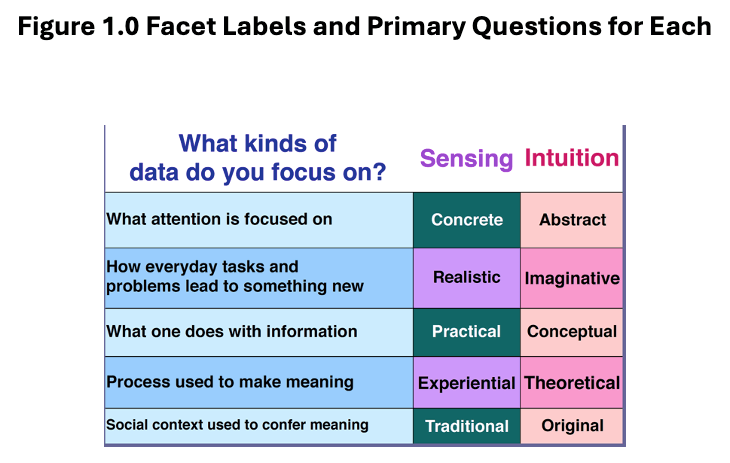
The narrative gets interesting when a learner sorts Sensing and has Facets that are, for example, Imaginative, Conceptual, or Theoretical. An individual may be very clear about a Sensing preference and through a host of life experiences may have developed and enjoys using Facets most often associated with Intuiting. Keep in mind that type theory posits that all of the preferences and mental functions are at work within an individual—just in varying degrees of conscious awareness. So, we should not be surprised when an individual has Facets that score opposite the sorted preference. When we ask a learner how the behaviors associated with the Facet are demonstrated and how they may have been learned, the learner can reveal a great deal about learning from experience.
Not all Facets have the same “power” relationship with the associated preference. For example, the first Facet in each preference dimension has the strongest association with the preference, and the middle Facet has the weakest relationship— with exception of the J-P Facets, where the second Facet has the strongest relationship. This is important for a number of reasons. If an individual has a low preference clarity score for Sensing (say a 1 or 2) and a 5 Facet score on Abstract, there is a very good chance the true preference is Intuiting. Conversely, if the preference clarity score for Intuiting is low but the Facet score of 5 for Concrete shows up, the true preference is likely Sensing. This is true for all of the Facets in the profile: the first Facet is a core aspect of the Preference.[i]
The middle Facets have the weakest relationships with the Preferences. In the case presented in Figure 1.0, the Practical-Conceptual Facet is very much affected by life experience and daily activities. We should not be surprised or overinterpret a score of 4 or 5 in either direction as it relates to the Preference. The Questioning-Accommodating Facet in the T-F dimension is the single most variable Facet on the entire profile.
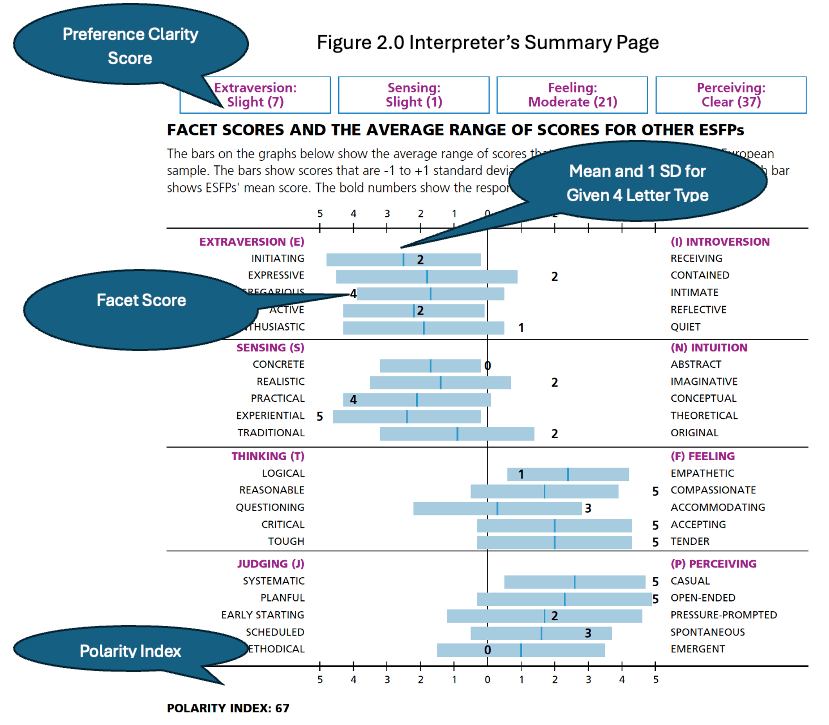
The last page of the Step II profile report is incredibly informative. Figure 2.0 presents an overview of these elements of the report:
- Preference Clarity Scores
- Learner’s Scores on each Facet
- The Mean and Standard Deviation (blue bar and dark line) for that type on each of the Facets. Each type votes differently on each Facet, and many Facets have a Standard Deviation that extends into the other Preference, which alerts you that it is common for a learner to score in that direction (opposite to the selected Preference).
The Polarity Index gives a robust sense of how consistent a learner has been on the profile. As a general rule, types with an Extraverted Perceiving function (Se, Ne) tend to have lower Polarity scores, and types with Introverted Sensing tend to have higher Polarity scores.
[i] See the Step II Manual for the statistical relationships between the Facets and the Preferences. Practical implications of this are covered in Pearman, Lombardo, and Eichinger. YOU: Being More Effective in Your MBTI Type.
Some Hints
The Polarity Index suggests that this learner consistently voted toward the various ends of the 20 continuums of the Facets. For example, 20 Facets with a 5 score would have an Index of 100. Such a score is extremely rare. It is easy to see by just looking at the means for ESFPs that the typical Polarity Index will be easily in the 60s. An Interpreter would expect the individual to quickly affirm the behaviors associated with the 4s and 5s.
Given the Preference Clarity Score of 1 for Sensing and the Imaginative and Original scores in the profile, teasing out which Preference seems more at play will be important. Note that the two Facets in the Intuiting direction are the two which in general extend over into Intuiting for ESFPs.
If type theory holds, ESFPs Extravert Sensing, the dominant function, which would be quite evident in the illustrations and examples the individual provides during the interpretation. Because the learner selected Contained and Quiet in the E-I dimension, it is reasonable to consider if there are situational pressures pushing against the individual’s natural expression of Extraverted Sensing—which might lower the Preference Clarity score.
Here is a checklist of considerations when looking at the Step II Report:
| In the interpretation, explore the current levels of stress or challenge or change the learner may be experiencing. What are the primary motivations for taking the assessment—career planning, life transition, developmental opportunity, etc.? Being under a great deal of stress may affect some of the Facet scores, as these are more situational. | |
| Review the Step I Four Letter Type and Confirm, Verify, or Identify areas needing clarity. | |
| Review each of the Facets within each Preference dimension; explore how much of that Facet the individual indicates is present “or at work within their style” given the scores. | |
| Look carefully at the first Facets in each Preference dimension to see if the scores are consistent with the Preference. If not, discuss other whole type configurations. For example, if the scores suggest a possible different type (e.g., ENTJ or ESTJ, etc.) be ready to explore what that might mean. | |
| The Interpreter’s Summary is not for the learner. It is an aid for interpreting consistency of patterns, areas of possible exploration, and evidence of how life experiences have affected how the learner operates in day-to-day life. Does the learner show stronger attraction (4 or 5) to Facets and are these scores even more evident than the typical pattern within the type? Or are the Facet scores generally in the standard deviation range suggesting a “typical response” for that four-letter type? | |
| Keep in mind that the report encourages the exploration of hypotheses of how the Preferences, type dynamic, and Facet behaviors contribute to well-being and effectiveness. There is no expectation that the report is the final answer. It is intended to promote further exploration. | |
| Review the tips and pointers outlined in the report which are designed to invite further exploration of the results. | |
| When a learner has a low Preference score in the dimension which would be the dominant function given the four-letter type, and the Facet scores are aligned with the Preference, then the individual is likely experiencing some challenges in the use of his or her preferred mental function. The challenges could be personal or professional. | |
| When a learner has a low Preference score in the dimension which would be the dominant function given the four-letter type, and the Facet scores are NOT aligned with the Preference, then the individual is likely unclear about his or her type and will need further guidance for type discovery. |
Myers noted that the four-letter type is the cake, and the facets are the icing on the cake. If we approach the Step II report in that spirit, we will add to the individual’s understanding of how to be more effective within his or her type and how their type can express itself so differently from those who share the same preferences.
[1] By 1969, Myers, using the statistical power of ETS computers, identified 26 subscales within Form F. She was interested in the subscales as indicators of type development and overall adaptability. Her findings:
E-I: Group Sociability, Detachment, Friendship, Freedom of Expression and Amusablity.
S-N: Acceptance of the way things are, Theory, Concreteness, Imagination, Intellectual Interests, and Enjoyment
T-F: Logic, harmony, Firmness, Warmth, Faith, Appreciation
J-P: Spontaneity, Planning, Organization, Application, Obligation, and Made-up-mind
She also had “sufficiency indices” which indicated degrees of type development:
- Confidence
- Compensatory Strain
- Stamina
She wrote, “The value of the breakdown lies in its significant sub-divisions of the various indexes. Based on factor analysis, these subdivisions deal with different manifestations of the same preferences, thus the profiles show type, whereas the breakdown depicts the personal variations that make the individual within the type.”
Myers’ data revealed that high Confidence, low Compensatory Strain, and High Stamina were essential to good type development. Later, following Myers’ death, Saunders analyzed all of the items Myers considered important, which produced Form J and the Type Differentiation Indicator, which included all of Myers special scales and a few more he found.
All of this work preceded the production of Step II as we know it today. Myers thought of the subscales as useful information for understanding the uniqueness of the individual, and with furthering of her work with FORM J, we had a detailed look at elements of individual strategies for adapting to daily challenges and sources of strain. Her fifth factor had what David Saunders called “comfort-discomfort scales” and these were (and key preference relationship) were:
- Guarded-Optimistic (T/F)
- Defiant-Compliant (T/F)
- Carefree-Worried (T/F)
- Decisive-Ambivalent (J/P)
- Intrepid-Inhibited (E/I)
- Leader-Follower (E/I)
- Proactive-Distractible (J/P)
In its current form, Step II data confirms the type dynamic hypotheses. If you look at the data details of the distributions by the sixteen types, it tells a very rich story of probable and likely patterns within each type. Further, some of the “facet” scales are so powerful that if an individual has a low preference clarity index score but a power facet score that is definitive, that facet is actually indicating the true Preference. For example, if an individual had a low preference score of Extraversion but a facet score of 5 for Receiving, the true type preference is Introversion. And, the middle Facet of each of the Preferences is highly affected by experience, such that the Facet score reflects the range of experiences in that dimension that an individual has had.
Much of the information above is available for researchers through the Myers Briggs Foundation; my sources are communications from Mary McCaulley, PhD., Naomi Quenk, Ph.D., and Katherine Myers. [1] See the Step II Manual for the statistical relationships between the Facets and the Preferences. Practical implications of this are covered in Pearman, Lombardo, and Eichinger. YOU: Being More Effective in Your MBTI Type.